
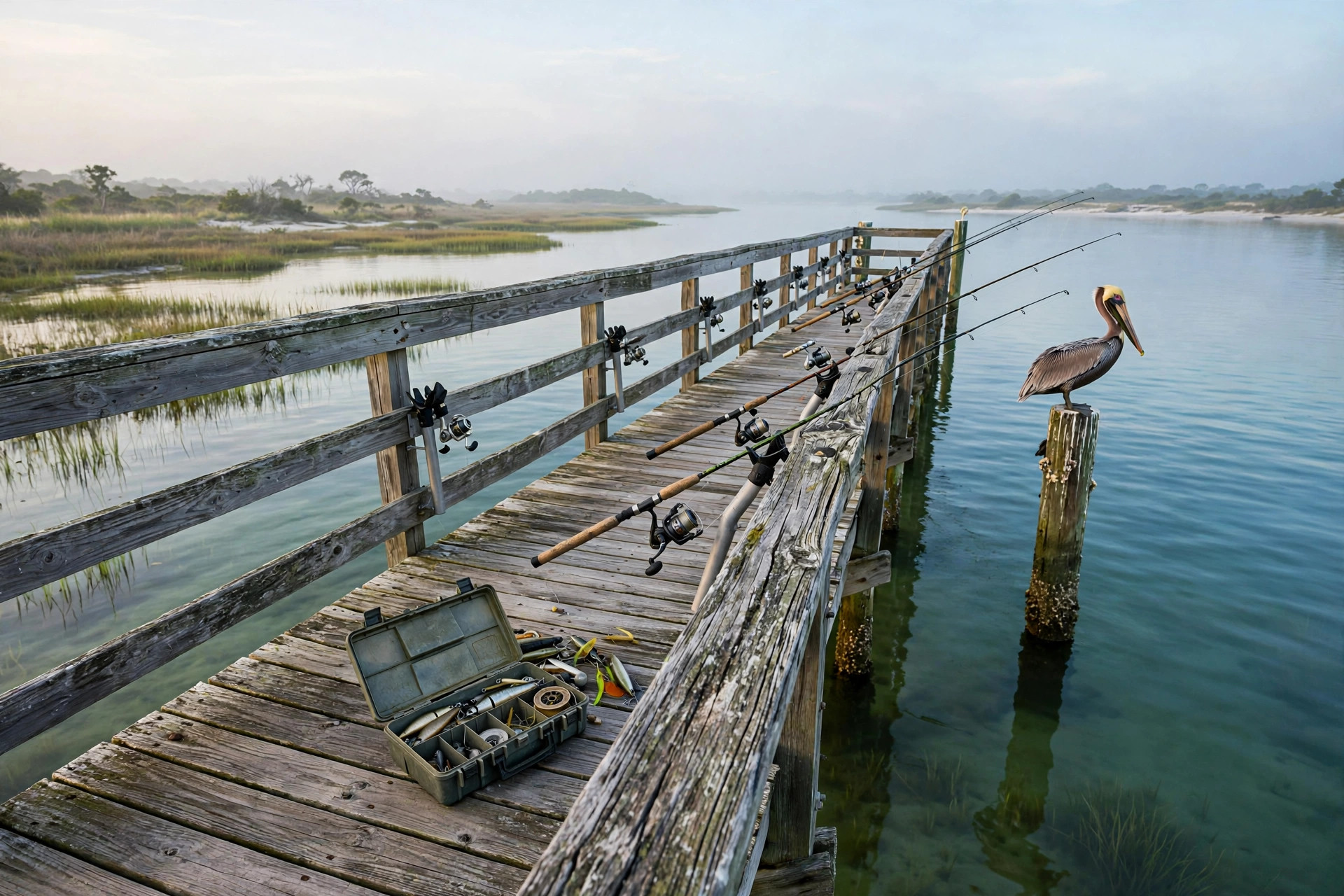
Fishing Without a Boat in Rockport-Fulton
This is the north-star query for Rockport-Fulton: you don't have a boat, you want to fish, and you need to know where to go, what's open, and what's biting. Everything below carries a verification date. A pier we can't verify is a pier we say we can't verify — never one we mark open from old information.
The journey: bait, then pier
The reliable no-boat trip runs in one chain: get bait → get to the pier → fish. Skip the middle step and you'll be standing on a pier with nothing on the hook.
- Bait first. Bait and tackle shops are the first stop — live bait, frozen bait, tackle, ice, and the local knowledge that matters most: what's biting this week and on what. Shop listings with verified hours live in our records; we don't publish a shop's hours from a stale listing.
- Then the pier. Pier statuses below are dated claims, not assumptions. Call ahead when a status is old.
Pier statuses (dated, verified, or honestly flagged)
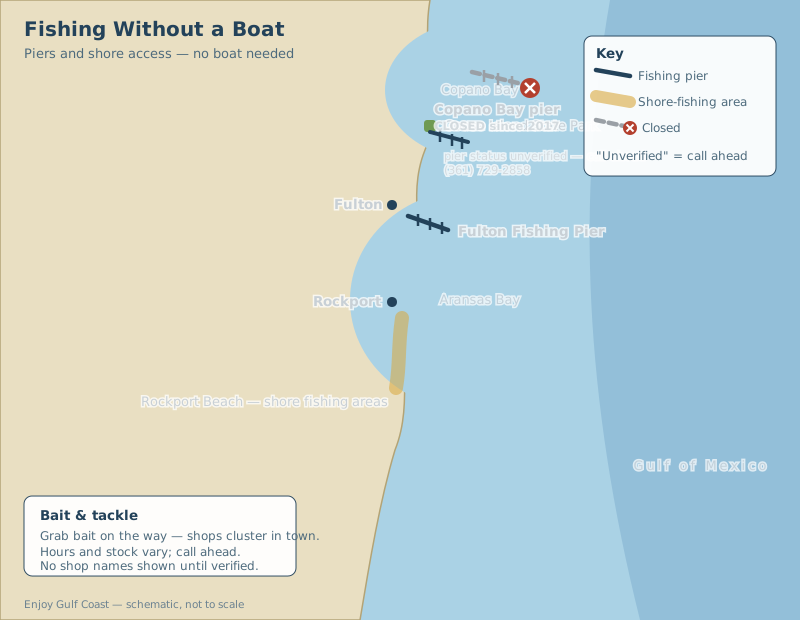
- Copano Bay Fishing Pier — CLOSED since 2017. We say this up front because it's the pier most stale sources still describe as open. It is not open. The page stays in our records with its closed status — closure is information.
- Goose Island State Park pier — status CONFLICTED. Sources disagree about whether the pier is open. TPWD lists a 1,620-foot pier at the park; fishing from shore or a pier at Goose Island needs no fishing license (per TPWD). Before you drive out, call the park at (361) 729-2858 to confirm the pier's current status. The park itself is $5 adult / free 12 and under (TPWD, time-sensitive), open daily 6am–10pm, and often reaches capacity — reservations are recommended.
- Fulton Fishing Pier — $5 per rod, per 2021 sources. That figure is old and needs re-verification before you trust it. Call or check locally; we will update the number when a current source lands.
- Town piers and shore access points — Rockport and Fulton maintain shoreline access beyond the named piers. Each access point in our records carries its own status, status date, and source.
Rule we hold: no pier renders as usable from a stale status. If we can't verify it's open, the page says so.
Licenses
Texas requires a fishing license with a saltwater endorsement for most saltwater fishing — current figures: $35 resident / $63 non-resident license, plus a $10 saltwater endorsement (TPWD, time-sensitive — re-verify before you buy). Exceptions exist: fishing from a Texas state park's shore or pier (Goose Island included) requires no license. Buy and verify at tpwd.texas.gov — licenses, regulations, and size/bag limits live with TPWD, never with us.
What to target, by season
Fishing opportunities here are TPWD-sourced and seasonal. The bay system — Aransas Bay, Copano Bay, St. Charles Bay — holds redfish, speckled trout, flounder, black drum, and sheepshead, with species moving by season and tide. The details of what's biting now change faster than any guide can print, so:
- Check TPWD fishing reports (labeled as TPWD data when we show it — it's theirs, not ours).
- Ask the bait shop. Seriously. The person selling you shrimp knows more about today than any website does.
- Seasonal patterns exist (fall flounder runs, winter trout, spring reds), but treat them as patterns, not promises.
Weather and water safety
This is the safety rule: check the marine forecast before you go — we never give our own weather or water advice. The authoritative source is the National Weather Service / NOAA marine forecast and tide pages. Piers are exposed; weather on the bay turns fast; the forecast is the decision-maker. We link the NWS/NOAA pages and re-verify the links regularly. They are not our data.
I brought my boat
Different journey, same shoreline. The brought-a-boat route runs marina or ramp → fuel, bait, and ice → water access → the bays → marine safety. Marina records carry per-service profiles (fuel, bait, ice, pump-out, transient slips — each a dated claim, never assumed), and boat ramps are recorded as access points. Offshore and deep-water detail is reserved for a later version.
Cook your catch
Catching dinner is half the evening. The Evenings guide covers the cook-your-catch custom — where to get your fish cleaned and cooked, and the waterfront patios where the rest of the night goes.